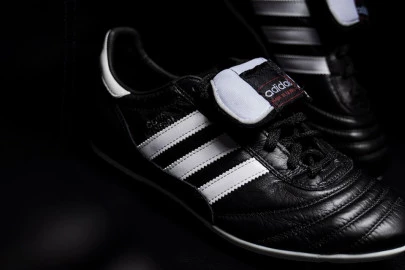
This week we’ve seen some of the leading adizero F50 ambassadors wearing some unfamiliar boot designs. These boots no longer look like prototypes, but rather like the final product. Could this be a new generation of adizero F50s? Everything suggests we’ll be hearing more about this soon.

So, what better time to take a brief look back at the history of the adizero F50? A range that struggled to break into the market, but which eventually found its niche, going on to become the boot that challenges the Predator for dominance at adidas.
We have to go back to 2004, a year when adidas had only two boot ranges: Copa Mundial and Predator. At that time, adidas realised that a new range was needed – one that was much lighter and better suited to attacking players. It was with this in mind that the F50 was born (the adizero would follow later).
1st GENERATION. adidas F50 (2004)

It broke the mould when it was launched. The three characteristic adidas stripes had disappeared. Furthermore, the area of natural leather was significantly smaller than the synthetic surface. This was something other brands had already adopted, but for a brand as traditional as adidas, it was unthinkable. Goalkeepers such as Cañizares and César Lainez, and strikers such as Diego Tristán and Del Piero, were the pioneers.
2nd GENERATION. adidas F50+ (2005)

Just one year later, a minor update was released, introducing interesting functional improvements such as a Velcro fastening to cover the laces and a PVC structure to balance and stabilise the synthetic part. Furthermore, the three stripes made a return to the design. They proved popular amongst footballers, but their lifespan was very short. Adidas was preparing a radical change for this fledgling range.
3rd GENERATION. adidas F50.6 Tunit (2006)

The 2006 World Cup was being held in Germany, adidas territory, and the brand with the three stripes wanted to make a splash… And it did, although perhaps not quite as they’d expected. Adidas designed a ‘tuneable’ boot where you could choose between different uppers (lighter or heavier), different chassis (with varying levels of cushioning) and three types of studs (SG, FG and AG). It was a brilliant idea and proved exceptionally well-suited to professional football… though not so much to amateur football. A product subjected to so much stress and made up of so many different parts inevitably ended up requiring constant replacements. Although it will go down in history for one thing: they were the first Adidas boots to be officially worn by the man who would become the face of the Adidas brand for the following decade – Leo Messi.

4th GENERATION. adidas F50.7 Tunit (2007)

There are few changes compared to the previous generation. The design and microfibre panels have been redesigned to give it a sleeker look. After a year on the market, and once the initial scepticism had been overcome, it began to become one of the most sought-after boots. The fact that Leo Messi is one of the players who wears them is key to everyone wanting a pair of F50 Tunit boots on their feet.
5th GENERATION. adidas F50.8 Tunit (2008)

This boot, like all those launched in 2008, holds fond memories for Spaniards. These are the boots that adidas launched for Euro 2008. David Villa was the face of this range for the Spanish national team. Wearing them, he scored some crucial goals that helped Spain be crowned European champions. Aesthetically, the standout feature is the large transparent window in the heel area, called ‘Alles Klar’, which, amongst other things, helped reduce the boot’s weight by 30 grams. To put this into perspective, the boot weighed 330 grams – light for its time… but incredibly heavy by today’s standards. Fancy seeing some adverts from back then?

6th GENERATION, adidas F50.9 Tunit (2009)

2009 was not a World Cup or Euro year, and this was reflected in the evolution of the F50 Tunit. It was a simple aesthetic change with no technological changes for the players. The adidas branding – the three stripes – was more prominent than ever. But a major change was in the offing at adidas. The Tunit system had run its course, and players were increasingly demanding lighter boots.
7th GENERATION, adidas F50.i Tunit (2009)

This model was the Tunit system’s swan song. But far from being a mere afterthought, it was a boot that introduced some very interesting features which would be used in future models. Of particular note is the SprintSkin synthetic microfibre – a very lightweight, stable material offering fantastic ball feel. This boot had its moment in the spotlight when Leo Messi scored a header in the 2009 Champions League final. As he took the shot, one of Leo’s boots fell off. Whilst celebrating the goal that secured his third Champions League title, Messi picked up the boot and kissed it. Could there be a better advertising campaign for adidas than this image?

8th GENERATION, adidas F50 adizero (2010)

2010, the year of the World Cup. It’s time for a revamp… And the F50 range does it in style. The introduction of SprintFrame technology enables adidas to jump on the bandwagon of ultra-lightweight boots that a rival brand had pioneered a few years earlier. And it does so in style. An ultra-lightweight boot weighing less than 200g, an extremely low profile, studs designed to provide traction at top speed… The Predator’s reign as adidas’s flagship range is under threat. Messi, Villa, Robben, Benzema and many of the top players of the moment were quick to jump on the adizero bandwagon.
9th GENERATION, adizero F50 (2011)

adidas has redesigned the adizero F50’s styling without straying too far from the original concept. Efforts have focused on optimising contact between the ball and the boot. To this end, the German brand has introduced a silicone compound that enhances the boot’s grip. Perhaps the most significant innovation in this generation was the inclusion of an elite model called the ‘F50 adizero Prime’, which reduced the weight even further. adidas even reduced the weight of the laces to create the lightest boot in history to date. The F50 adizero Prime weighed just 145g:

10th GENERATION, adizero F50 (2012)

The 2012 model focused on improving the fit between the boot and the foot. To achieve this, adidas introduced a component (marked in yellow on the boot) that tightens the boot around the foot when the laces are pulled. This new adizero F50 was slightly heavier than the previous generation, but it began to strike a balance across the three key parameters a boot must deliver: lightness, support and ball feel. Interestingly, it is the first model to feature a slot in the sole for inserting the miCoach sensor.
11th GENERATION, adizero F50 (2013)

The 11th generation did not represent a major change. The shell was streamlined to give the adidas branding greater prominence, and the area of gel bonded to the shell was increased to improve ball feel. Once again, there was a reduction in weight, but nothing compared to the next generation.
12th GENERATION, adizero F50 (2014)

And so we come to the current model. The 12th generation, which has changed very little in terms of aesthetics compared to the previous model, does, however, conceal a major change in terms of functionality. The Sprintskin synthetic material, which has featured on the boot since its launch, has been phased out and replaced by a heavier microfibre, which offers a much more natural fit and feel when striking the ball. In keeping with its tradition of reducing weight, adidas has introduced a cut-out section of material in the area that does not come into contact with the ball and has incorporated the lightest microfibre used to date: Speedfoil. This microfibre is so thin that it is even semi-transparent.
13th GENERATION, F50 Adizero 5 (2014-2015)
It was 2015 when adidas developed the adizero F50 and launched the new generation onto the market. The upper is made from HybridTouch, a synthetic microfibre designed to resemble natural leather whilst eliminating its ‘flaws’: weight and water absorption. To replicate the fantastic grip on the ball offered by natural materials, the new generation of adizero F50 features a silicone called Dribbletex across all areas that come into contact with the ball. The SprintFrame was phased out and a completely minimalist heel counter was introduced.

And finally, the sole. It’s not an element that tends to attract much attention, but in the case of this boot – designed to maximise a footballer’s speed – it’s important for the player to have good support whilst running. That is why one of the innovations in this new generation was the arrangement of the SpeedStud studs. On top of conventional adidas Traxión 2.0 studs, adidas reinforced one of the three edges of each stud to provide grip whilst running. Furthermore, a central row of studs acted as a backbone to stabilise the boot during twists or aggressive foot strikes.
The lightest boots on the market
Adizero F50 99 gr

Following the events of 2014, when the competition launched the first sock-like boot, adidas had to make a bold statement – and make one it certainly did. Just over a month ago, we reviewed the adidas X99.1 remake. The German brand launched the adizero F50 99 grams, the lightest boot of all time. In fact, the test pair that adidas sent us weighed just 95 g, and it was a size 42.5 (UK 8.5). The key to achieving this incredible weight reduction lies in the choice of materials. The German brand spent several years testing up to 60 different materials before finding the combination of PU and polyester foam that forms the shell of this boot.
Of course, this is during sprints at top speed, but footballers don’t just run forwards in a straight line. They also change pace, accelerate and brake, and change direction… And the world’s lightest boot had to provide traction for all these movements. Did the 99-gram adizero F50 manage it? Absolutely. And the key lies in its outsole with the SpeedStud stud configuration, where the largest edge of each stud is oriented in a specific direction to ensure support at all times during these movements.