In football, all positions are equally important. However, because of the goals they score, the general public tends to cheer on attacking players the most. So, for all those who dream of becoming strikers, today we’re going to share some tips on how to improve your game through some very simple exercises.

If there is one type of player who needs to undertake a variety of training sessions – or who, at the very least, should perform different exercises specific to their position on the pitch – it is the striker, or, more generally, the most attacking players. We are constantly seeing how football is evolving: new tactical systems, new types of pitches to play on, new and increasingly sophisticated football boots… That is why, year after year, footballers must reinvent themselves, both individually and as part of their team training.
Specific football training exercises for strikers
For a footballer to train and develop in the most effective and consistent way, they need access to a whole range of specific equipment suitable for football training, such as training kit, football boots, cones, a stopwatch, an agility ladder and, at the very least, a ball. All this equipment will help you improve your performance during training sessions and, consequently, better assess your abilities in all areas, such as timing your sprints with and without the ball. In this way, you’ll push yourself to work harder on the areas where you need to improve, and this will, in turn, help you develop as a player.

Strength training
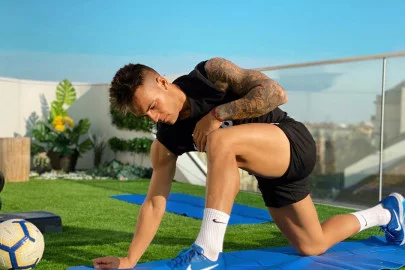
Whether you’re a striker or any other player on the pitch, if you play football you must – or at least you should – look after your fitness. If you don’t have access to a gym at your club’s facilities or have to use one on your own, believe us, it will only be to your benefit. Regular strength training, always under the guidance of a qualified coach, will help you build adequate muscle mass and excellent physical fitness. Exercises such as leg presses will help you improve your endurance, agility and speed, as well as your ability to hold your own against opponents on the pitch. The elliptical trainer is a piece of kit that often takes a back seat amongst men, perhaps due to certain preconceptions, but its benefits are enormous and are particularly linked to motor skills and agility. Another machine you can use to round off your gym training routine is the treadmill – the traditional running machine. With this machine, you can improve your physical fitness as well as your endurance.

Ball control training
This is perhaps one of the most common exercises in any football team. However, when carried out correctly and adapted to the team’s style of play on the pitch, it can be very effective, as it increases a team’s chances of maintaining high ball possession during a match. To carry out this exercise correctly, you must place several football training cones at random across the pitch. The player must weave their way around them as quickly as possible, keeping the ball close to their foot at all times. The exercise should end with a shot on goal, simulating a situation of attacking superiority in which the striker has beaten their defenders and finds themselves one-on-one with the goalkeeper. We recommend keeping a record of your times so that you can improve your performance in this exercise based on the results you achieve.

Exercises with resistance bands
This exercise will help you build and improve your endurance and speed. It all depends on how long it takes you and your explosive power to complete the course. To do this, you’ll need to place an elastic band around your waist and, if you have a partner to help, they should hold the ends in their hands. If you’re training on your own, we recommend tying the ends of the band to a weight. You should set out a course and run as fast as possible from one end to the other. If you have a training parachute, this exercise will be much easier to perform and the benefits will be even greater, as the difficulty increases.

Sprint finishing exercises
The most attacking players have the goal as their main target and, for this reason, must be physically prepared to reach the finishing zone as quickly as possible, as many times as necessary, and always be in a position to finish the move with a goal. To work on your sprinting so that you can reach the finishing area in the best possible position to score, you should run from the centre of the pitch to the box and finish the move with a shot, whether following a through ball or a cross from distance. In this exercise, you should note the time it takes you to reach the box and how many times you manage to finish the move with a goal.

Dribbling and run-off exercises for a striker
This is perhaps the most difficult exercise to carry out, as it simulates a real match situation. The aim is to provide the striker with the tools they need to learn to read the game for themselves, to know how to position themselves amongst opposing players, and also what sort of dribble to use depending on the situation they face. To carry out this exercise, you must stand face to face with an opponent, and both of you must try to get the better of the other. The defender’s role is to make things as difficult as possible for the striker, trying to win the ball back at all costs, whilst the striker must beat the defender’s marking and score a goal. For this exercise, we recommend using small goals (which you can find for sale at Fútbol Emotion), so that you can train against a teammate who is also a striker and work together on your ability to win the ball back.

And these are just some of the areas a striker needs to work on to succeed in the world of football. If you follow this advice and stick to a healthy diet, as well as leading a healthy lifestyle, you’ll see your skills improve.