All the World Cup footballs
URUGUAY 1930
In the final of the 1930 World Cup in Uruguay, there was still no such thing as an ‘official ball’. Each team played with its own ball. When Argentina and Uruguay reached the final, both wanted to play with their own ball. Finally, a decision was made that would never be seen again: the first half would be played with the ball provided by the Argentine team (Tiento ball) and the second half with the ball provided by the team that ultimately won: Uruguay (T ball).
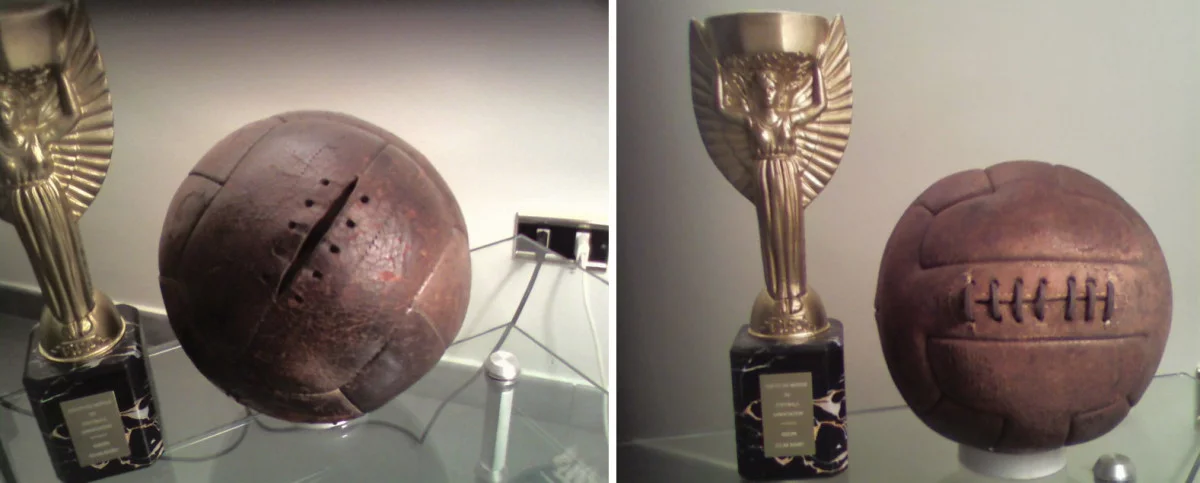
On the left, the Tiento ball (Argentina) and on the right, the T ball (Uruguay) at the FIFA museum.
ITALY 1934
Following the controversy surrounding the 1930 final, FIFA made a decision that would remain in place for all World Cups until the present day: the first official ball, identical for all World Cup matches, was introduced and named Federale 102. A total of 12 Federale 102 balls were used during the World Cup.
The ball did not come from a specific brand as it does today, but was commissioned from an Argentine company called Tossolini, Valbonesi, Polo & Cia because it had invented the Superball system, which eliminated the problem of the lacing that all balls of that time had (the lacing is the leather cord that closed the ball on the outside, as if it were a shoe). The first seamless ball with an invisible mouth left the Argentine factory in 1931 and was put to the test at the 1934 World Cup.
Although all this seems ridiculous to us now, the seamless lacing system was a revolution that even changed the appearance of footballers: if we look at images of footballers from the 1920s and 1930s, we often see them wearing berets, not for fashion or vanity, but for protection. Heading the ball often caused cuts on the forehead because, with the sun and humidity, the leather on the ball became as sharp as a knife.
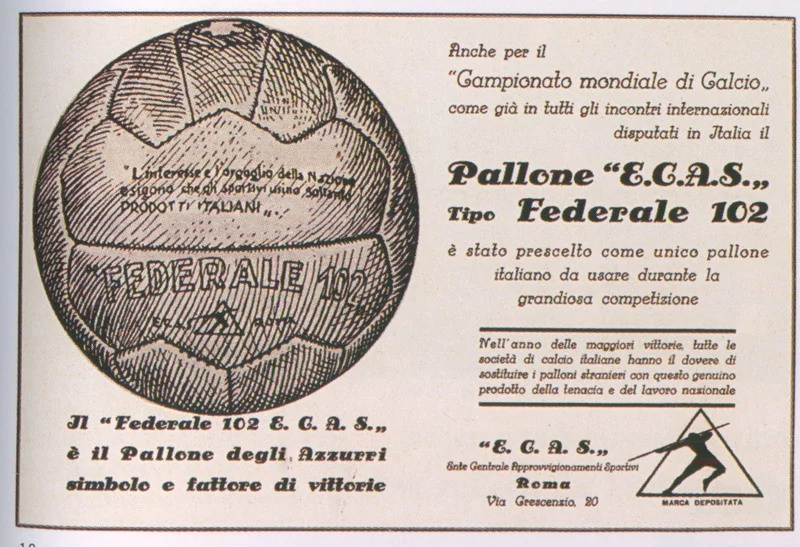
Promotional poster from the era of the Federale 102 football
FRANCE 1938
For the 1938 World Cup, the Allen ball was chosen. Once again, it was a ball developed by a private company rather than a sports brand. It was basically a continuation of the ball used four years earlier in Italy, featuring the Superball system to prevent the annoying seams that form the stitching.
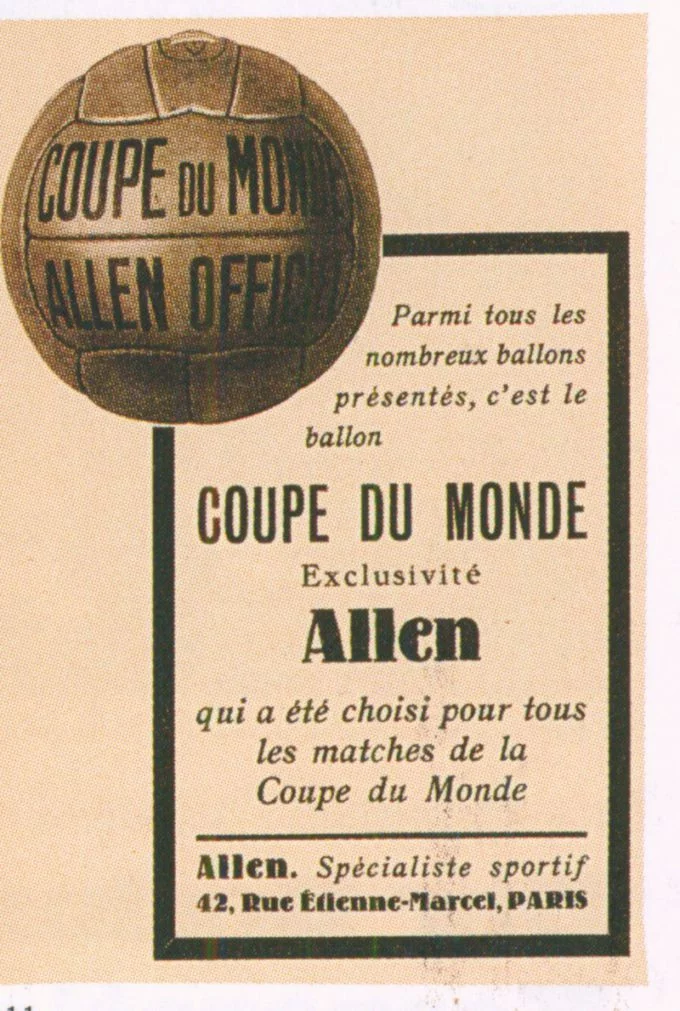
Promotional poster for the Allen ball
BRAZIL 1950
After the hiatus caused by World War II, the ball rolled again at the 1950 World Cup in Brazil.
A draw was enough for Brazil to become world champions in a packed Maracanã stadium with 174,000 spectators who saw Uruguay defy all odds and be crowned world champions in the historic Maracanazo.
The ball used in that final was the Super Duplo T. The 12 years that had passed since the 1938 final in France had allowed for better materials to be used in the manufacture of the ball. More tanned leather, more concealed and firmer seams... resulting in a much more spherical, lighter and more reliable ball.
The ball used in the final is preserved in the American Soccer Museum in the United States. Below you can see an image of its current condition, more than 60 years after it was last kicked:

Current state of preservation of the Super Duplo T
SWITZERLAND 1954
For the 1954 World Cup held in Switzerland, a ball with 18 stitched panels and no external seams was used. The name of the ball in question is SWISS WORLD CHAMPION, and it has a notable feature in addition to the absence of external seams: its orange colour.
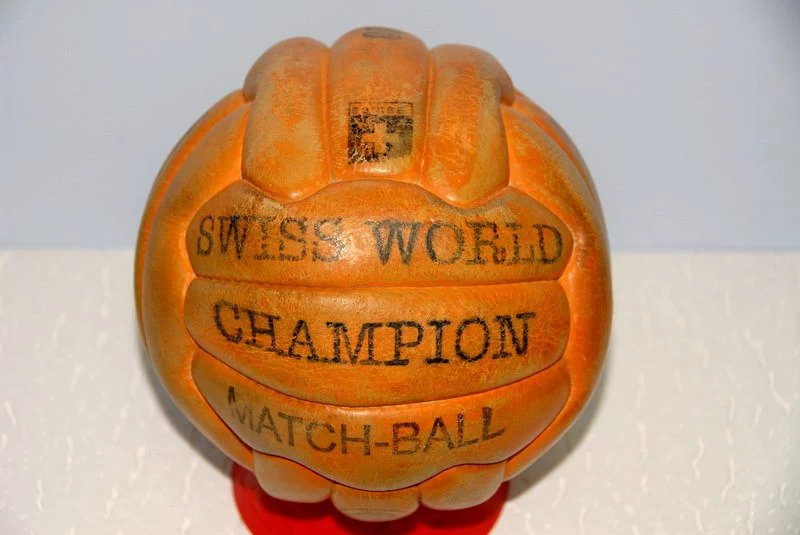
Current state of preservation of one of the footballs that rolled across Swiss pitches in 1954
SWEDEN 1958
The ball used in the 1958 World Cup in Sweden was the TOP STAR. It was a 24-panel ball manufactured for the World Cup in two colours: one in yellow/brown leather and the other in white leather. The qualifying rounds were played randomly with balls of both colours, but in the final, all the balls were white.
For the first time, FIFA created a competition to choose the official ball. 102 balls were sent to FIFA. At the SvFF office at the Råsunda Stadium in Solna, Stockholm, a lawyer and a notary registered the balls and envelopes and numbered them from 1 to 102.
On 8 February 1958, four FIFA officials met in the morning at the FIFA offices and discussed the balls. After lunch, there were 10 finalists. After two hours, they decided that No. 55 was the winner, and Mr Stanley Rous named it the ball for the 1958 World Cup. The winning ball had 24 panels, and it was this high number of panels that made the difference in the selection process compared to the other balls.
The company ‘Sydsvenska Läder - el och Remfabriken’ in Ängelholm, Sweden, had produced the ball. They sent it to all the World Cup stadiums, each team received 30 balls when they arrived in Sweden, and some teams were able to purchase extra balls, as Brazil did. All the balls were still free of brands and stamps. On Sunday, 29th June, the company announced that the ball would be called Top Star, and this ball would also be used in some matches at the 1962 World Cup in Chile.
Ball No. 55 is still in a meeting room at the Rasunda Stadium in Stockholm.
The ball used in the final is in the Brazilian Football Confederation's office in Rio, as it was collected after the match by masseur Mario Americo from French referee Maurice Guigue, who ran to the dressing room and hid it there.
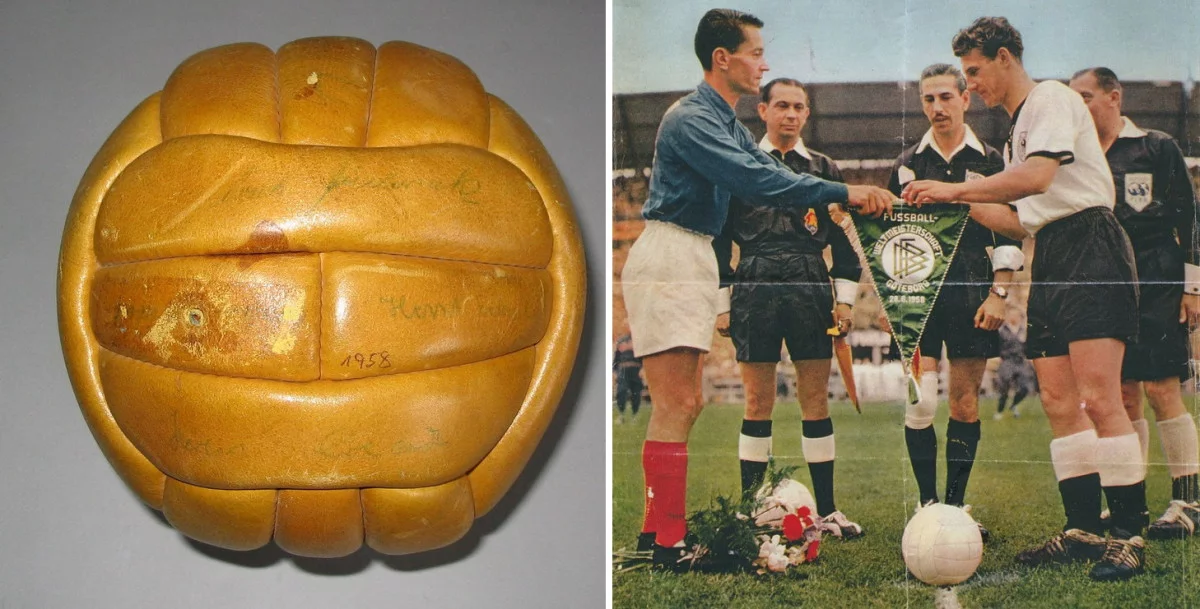
Ball number 55 (left), image of the kick-off between Germany and France (right)
CHILE 1962
The ball used in the 1962 World Cup in Chile was called Mr. Crack. The panels of Mr. Crack underwent significant modifications: only 18 yellow leather panels were used, and it was manufactured by Custodio Zamora Honorato's company, based in Santiago, Chile. After the World Cup, the Mr. Crack ball continued to be the official ball of the Chilean national championship for the next 18 years.
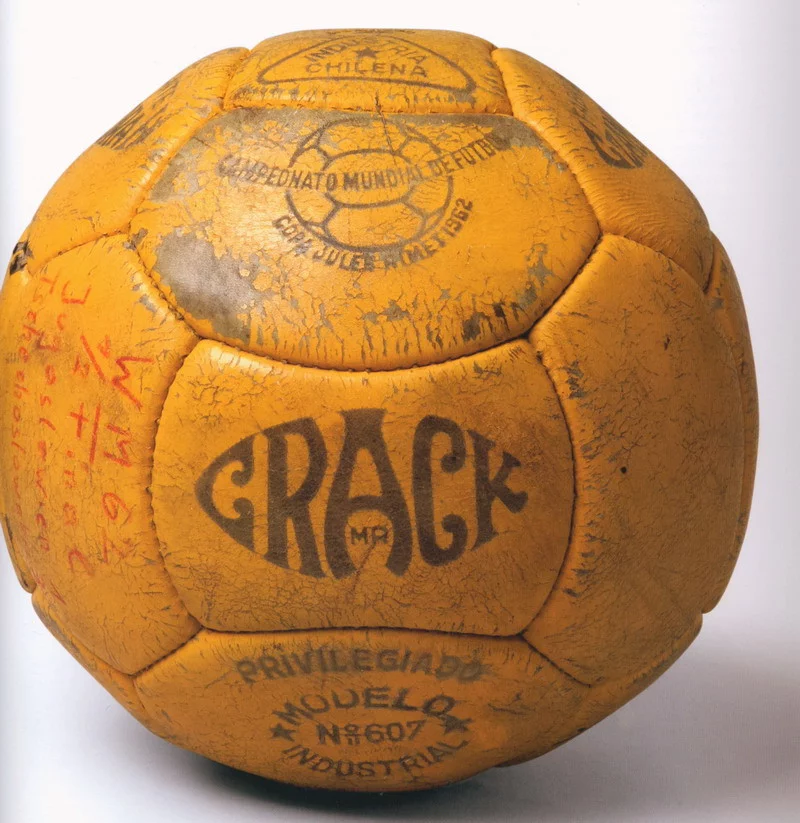
Current state of one of the Mr. Crack that rolled through the fields of Chile in 1962.
ENGLAND 1966
The Slazenger brand was responsible for manufacturing the ball in 1966, the year the World Cup was held in the country where football was invented. Many of you will be familiar with the brand because it is currently one of the leading manufacturers of tennis balls, including for Wimbledon.
The ball model was called Challenge and was made up of 25 panels. Interestingly, for the final between England and West Germany, Slazenger produced a special batch of Challenge balls in a striking orange colour, different from the rest of the balls used in the competition.
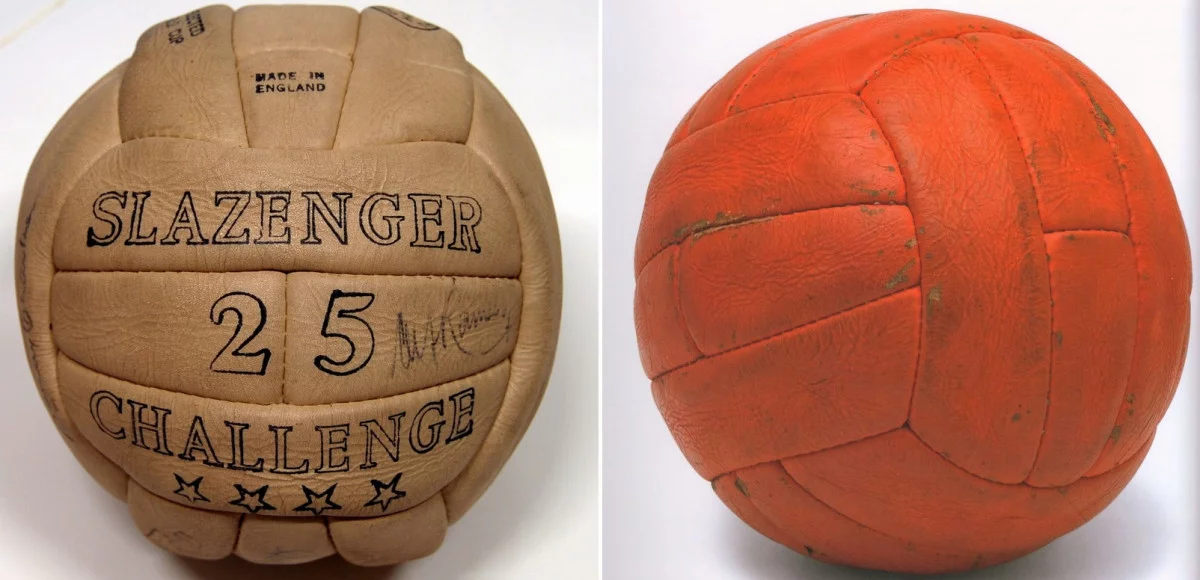
Slazenger Challenge ball (left), special orange version for the final (right)
MEXICO 1970
Adidas became the official supplier of footballs for the World Cup. And it did so in a big way, creating an icon: the Telstar. The revolutionary ball introduced two innovations that marked a turning point in football manufacturing and are still in use today:
- In order to achieve maximum sphericity, the panel system was changed to 32 pieces, combining pentagons and hexagons. Almost 50 years later, most footballs are still manufactured using this design.
- Its design was created with the aim of making it as visible as possible on television. The 1970 World Cup in Mexico was the first to be televised, so Adidas made every effort to ensure that the ball had maximum visibility on the black and white televisions of the time.
The name of the ball is derived from ‘Television Star’. Interestingly, they were manufactured in Spain and France. Asia had not yet become the world's sole manufacturer of footballs.
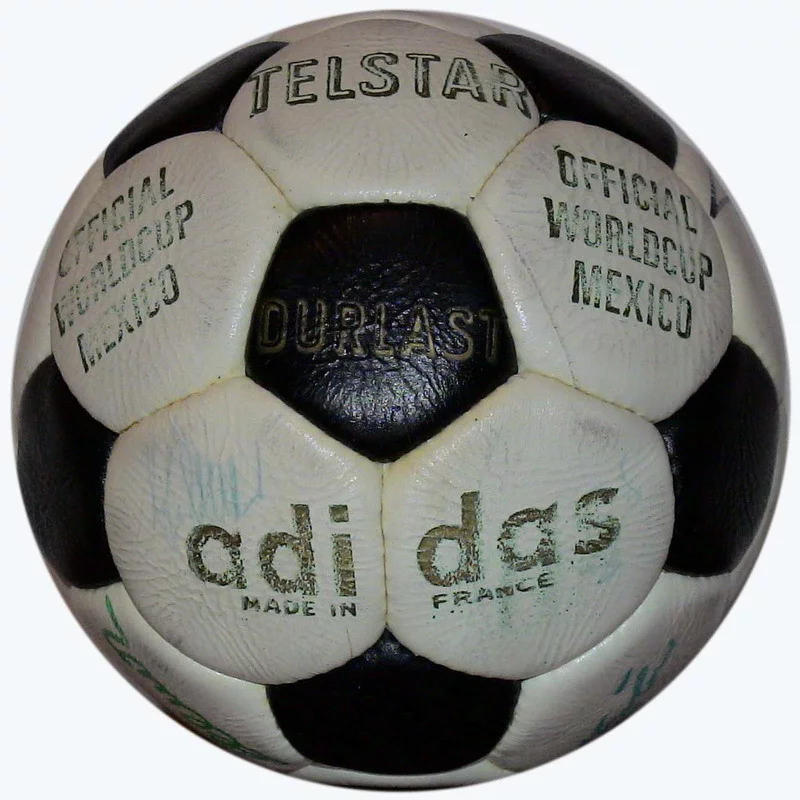
‘Made in France’ version of the official ball of the 1970 World Cup in Mexico
GERMANY 1974
In 1974, the World Cup was held in adidas' home country: Germany. The brand with the three stripes decided to play it safe and repeat its successful formula, continuing with the same ball that had triumphed four years earlier: the Telstar was once again the official ball of the World Cup. Once again, there were two versions, manufactured in France and Spain.
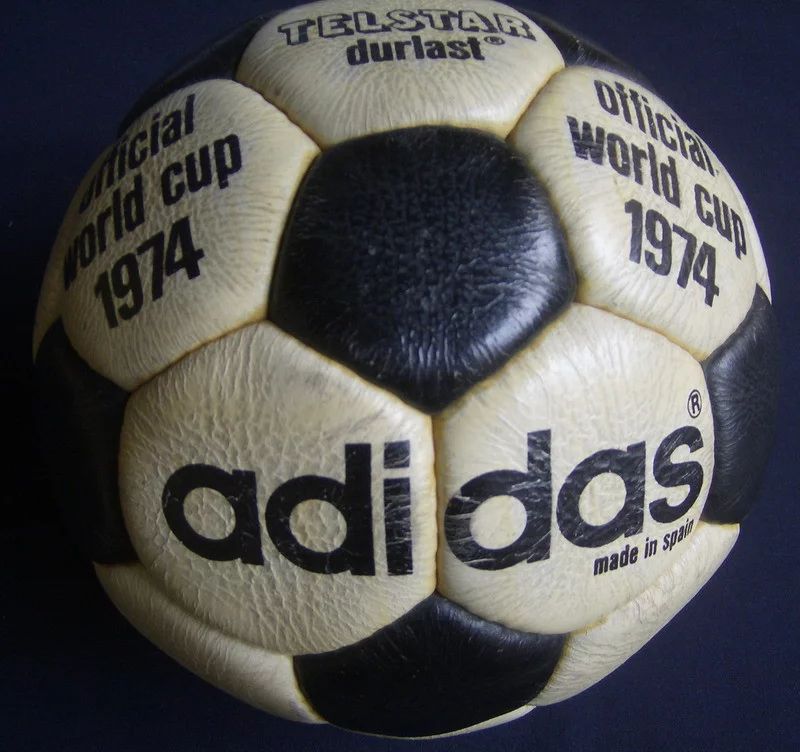
‘Made in Spain’ version of the official ball of the 1974 World Cup in Germany
ARGENTINE 1978
Adidas named the 1978 ball Tango Durlast, in an obvious reference to popular Argentine music. The German brand created a ball design that would once again mark a long era of ball design style. Both future Adidas balls and those of other brands imitated this style, in which 20 of the ball's 36 panels featured a triad that created an optical illusion of 12 identical circles, inspired by the intense passion, emotion and elegance of Argentina.
On a technical level, the Tango Durlast offered better waterproofing than previous balls.
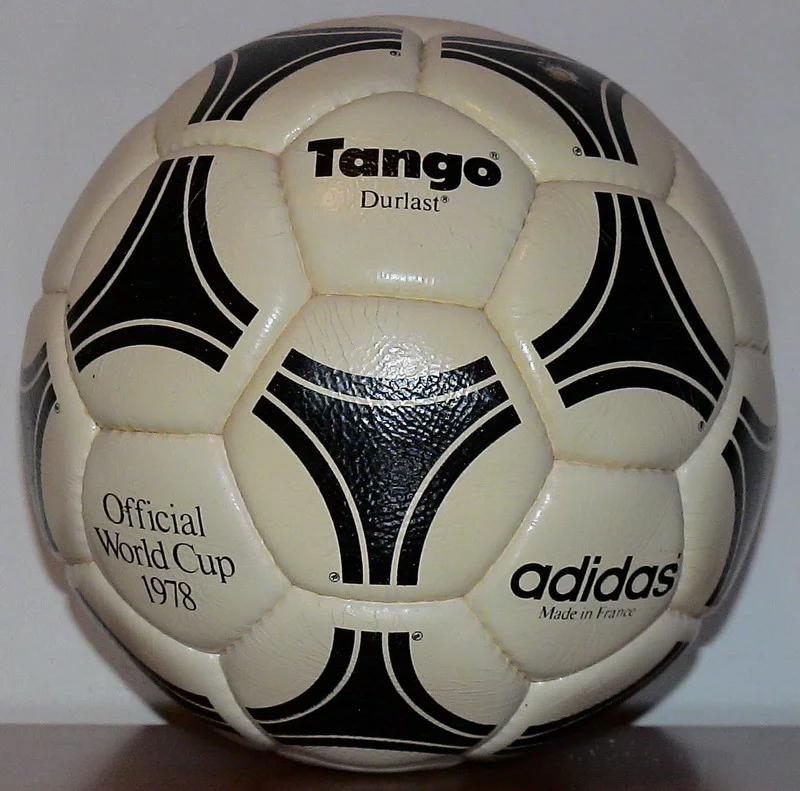
Current condition of one of the balls used in the summer of 1978 in Argentina
SPAIN 1982
This time adidas recycled the successful Tango design four years later for the World Cup held on Spanish soil. Although it may seem that Adidas was lazy in repeating the ball design, the reality is that a lot of work went into improving the ball. The Tango España is very different from the Tango Durlast in terms of functionality. The 1982 ball was still made of leather, but featured revolutionary waterproof stitching, which significantly reduced water absorption and therefore minimised the ball's weight gain during the match in case of rain.
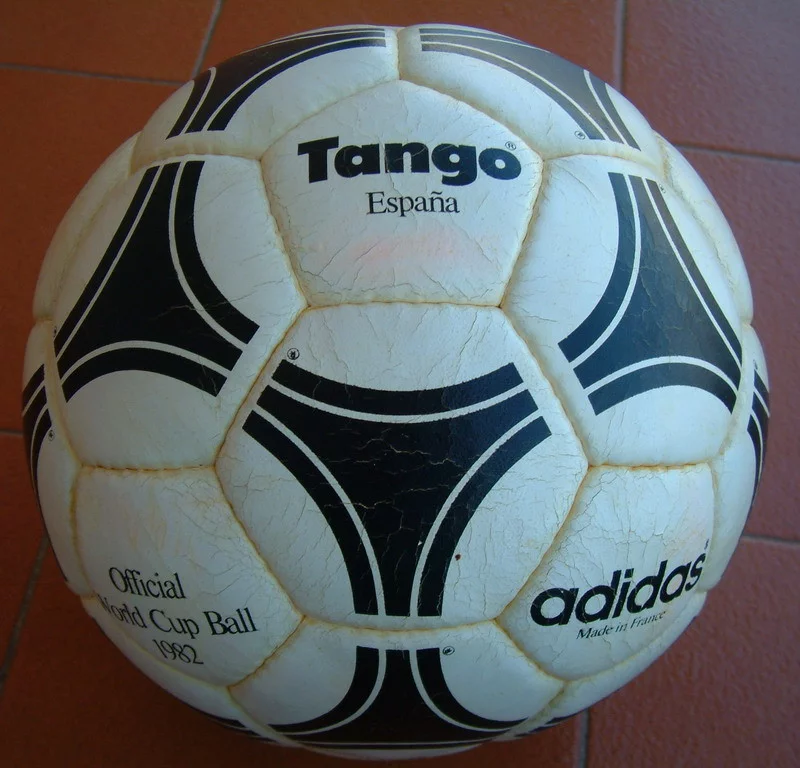
Ball used in one of the World Cup matches, different from those released by adidas.
MEXICO 1986
Mexico is one of the World Cups that has gone down in history for the level of play, the historic milestones that were achieved and the special atmosphere that was created around it. And adidas rose to the occasion with the creation of the Azteca ball, a ball whose name and decoration pay tribute to the indigenous peoples of Mexico.
As a technical element, adidas marked a turning point in the manufacture of footballs by eliminating natural leather and producing, for the first time, a professional-grade ball made of synthetic microfibre. The German brand thus sought to take a new step forward in improving the ball's water resistance and increasing its durability.
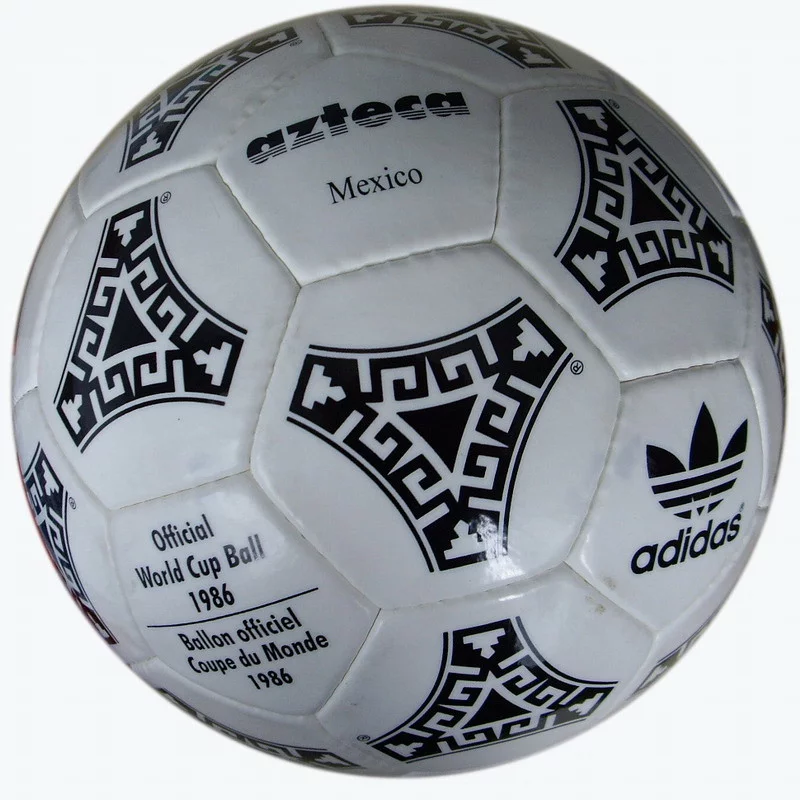
The adidas Azteca ball with which Maradona brought the football world to its feet in July 1986.
ITALY 90
Once again, adidas developed a true work of art for the 1990 World Cup in Italy. The Adidas Etrusco was inspired, both in name and design, by ancient Italian history and the artistic contributions and production of the Etruscans. Three lion heads decorated each of the 20 triads on this legendary ball.
For many sports collectors, it is the best football of all time, which is perhaps why it is one of the most sought-after items in collectibles shops.
The synthetic microfibre used by Azteca four years earlier underwent an evolution with a new external polish that made it more pleasant to the touch. But above all, it stands out for being the first competition ball in history with an inner layer of black polyurethane foam, making it more reactive to kicks, with better bounce and taking the waterproofing process one step further.
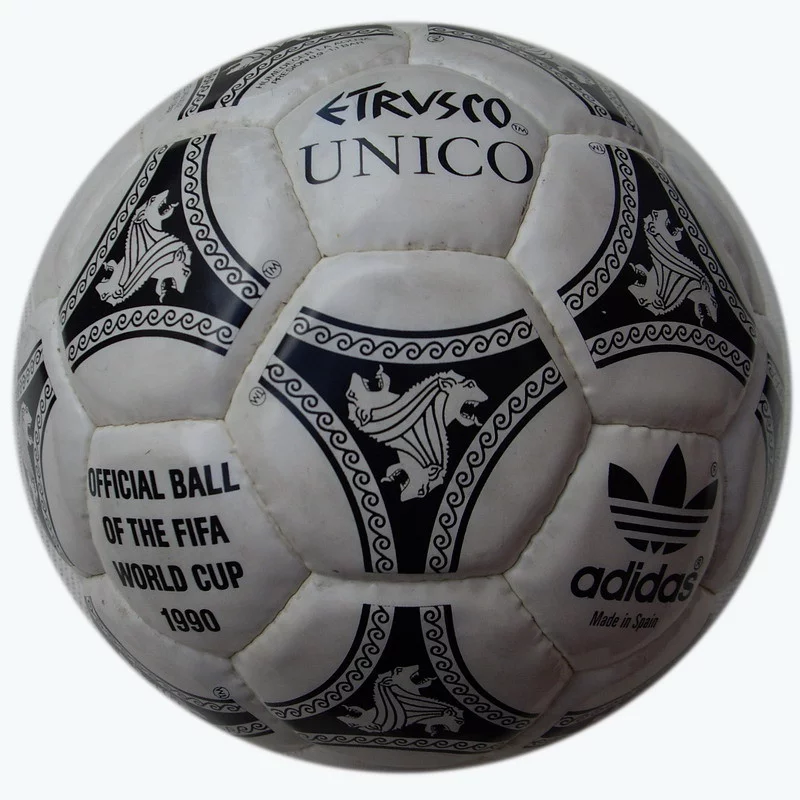
Due to its design and technical evolution, the Etrusco is considered the best football in history.
USA 1994
Four years later, the adidas Questra was the star of the football pitches in the summer of 1994. The inspiration for its design came from the aerospace industry, high-speed rockets and the American space race, which was in full swing at the time.
But the adidas Questra also set new standards in performance thanks to a layer of high-tech white polyethylene foam with enormous energy recovery, which made the Questra softer to the touch (more controllable) and much faster when kicked.

Original 1994 adidas Questra ball manufactured in Europe, something we will never see again in an official ball.
FRANCE 1998
There is a school of thought that considers the adidas Tricolore to be the “last beautiful ball” in World Cup history. The name and design were inspired by the tricolour flag and the rooster, traditional symbols of the French Republic and its national football team.
The birth of the Tricolore marked a turning point in the manufacture of footballs. Production in European factories came to an end and the big brands moved to cheaper countries. For many, footballs would never be the same again and lost some of their charm. The adidas Tricolore has versions ‘Made in Morocco’, ‘Made in Pakistan’ and ‘Made in Thailand’.
However, technologically speaking, the Tricolore is a significant leap forward from the Questra. The 1998 ball included a layer of synthetic foam, a material that further increased the ball's durability, energy recovery and responsiveness.
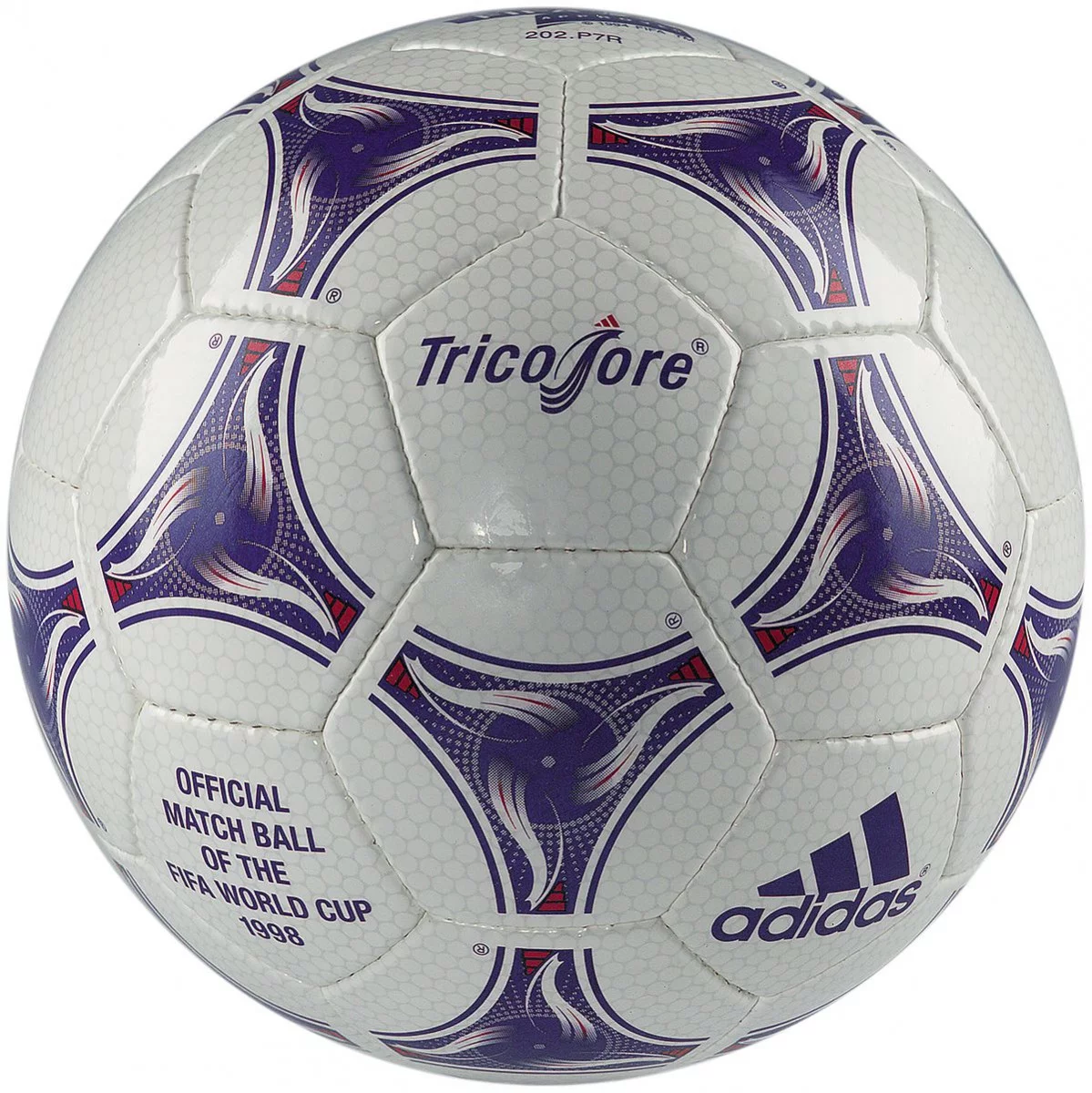
The adidas Tricolore ball, considered by many to be the “last beautiful World Cup ball”.
KOREA AND JAPAN 2002
A complete revolution in football design. In 2002, adidas launched the Fevernova, a ball that was a complete departure from the “Tango design” that had been in use since 1978. Its name, turbine-inspired decoration and use of colour were entirely based on the fever for innovation in Asian cultures.
On a technical level, the adidas Fevernova included a refined foam layer to give the ball better performance characteristics and a three-layer woven casing that allowed for a more accurate and predictable flight path with each shot.
The ball received strong criticism at the time of its launch, but the reality is that its acceptance by footballers was very positive.
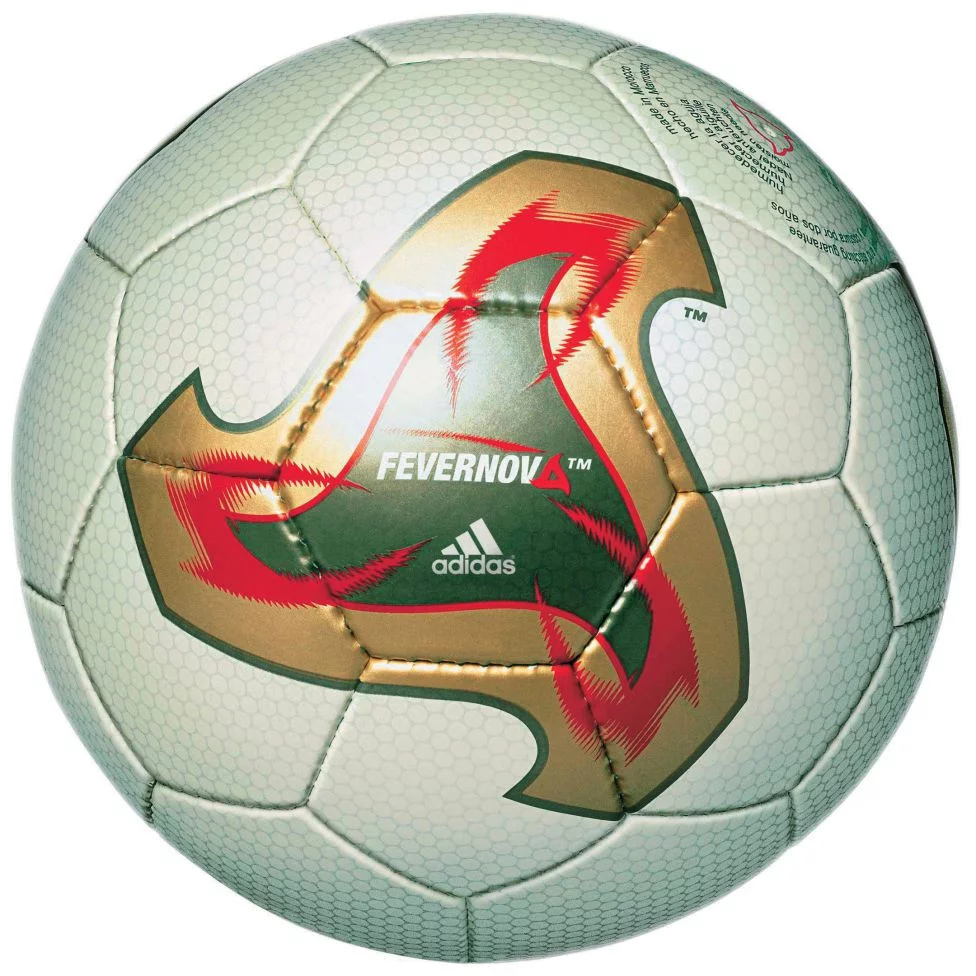
GERMANY 2006
The adidas revolution in ball manufacturing takes another step forward. The adidas +Teamgeist is named after a German term that refers to team spirit. For the first time in World Cup history, each ball was unique: every ball that rolled across German stadiums was personalised with the name of the stadium, the teams, the date of the match and the kick-off time for each game.
However, the real revolution lies in the disappearance of the 32-panel structure of pentagons and hexagons that adidas introduced in 1970. The adidas Teamgeist is made up of 14 pieces, reducing the number of contact points between the pieces by 60% and ultimately creating a more spherical ball.
It is also the first competition ball with sealed panels instead of stitched ones, meaning that water absorption is practically zero and the ball does not change its weight or shape regardless of the condition of the pitch.
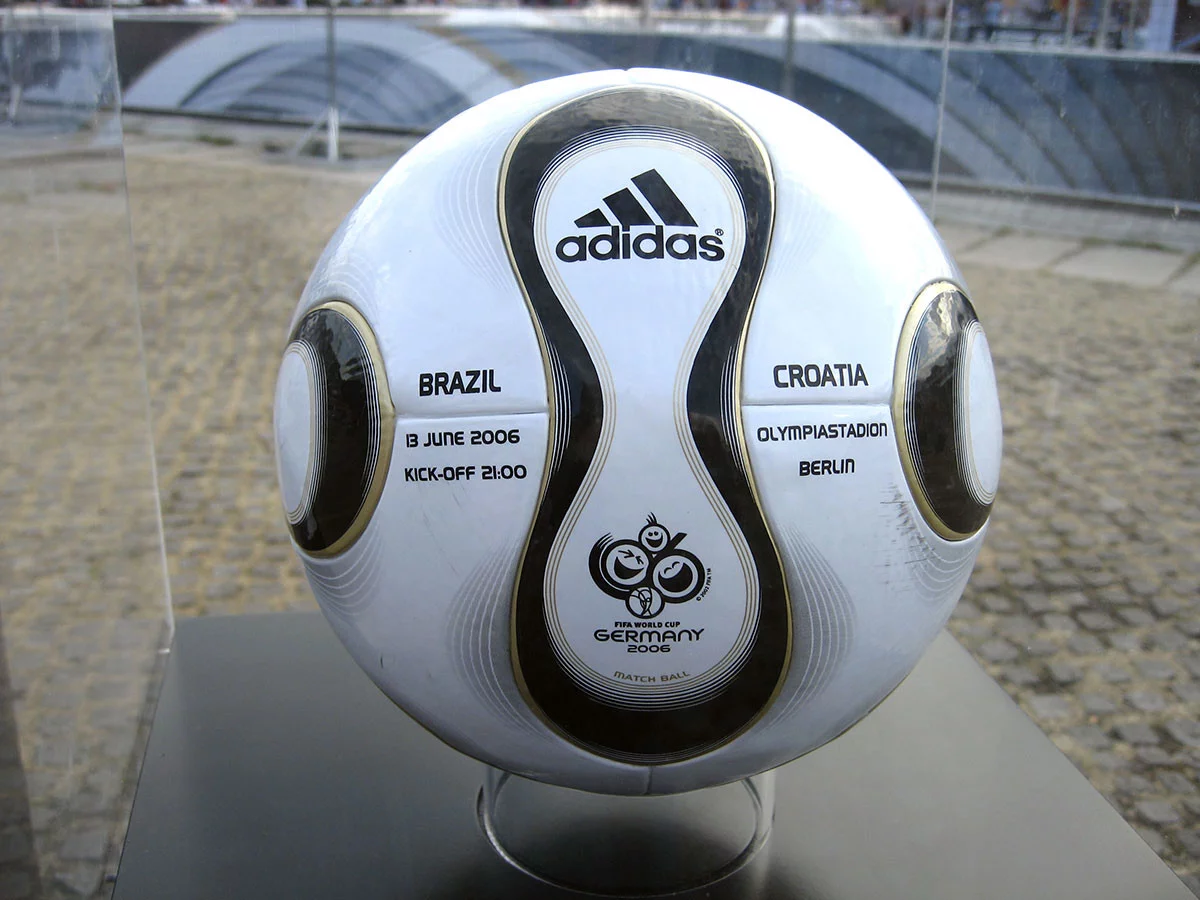
adidas +Teamgeist ball used in the Brazil vs. Croatia match on 13th June 2006
SOUTH AFRICA 2010
The Jabulani used in South Africa is unanimously considered the worst ball in World Cup history. The criticism was harsh, especially from goalkeepers due to its unpredictable trajectory and slippery finish.
The name of the ball is taken from the IsiZulu language, spoken by 25% of the population in South Africa, and in that dialect Jabulani means to celebrate.
Technically, this ball has eight three-dimensional EVA and TPU panels which, according to the German brand, would make it more stable, more accurate when shooting and, thanks to the 3D finish, easier for goalkeepers to grip.
The result was a complete failure and the ball went down in World Cup history as a disaster.
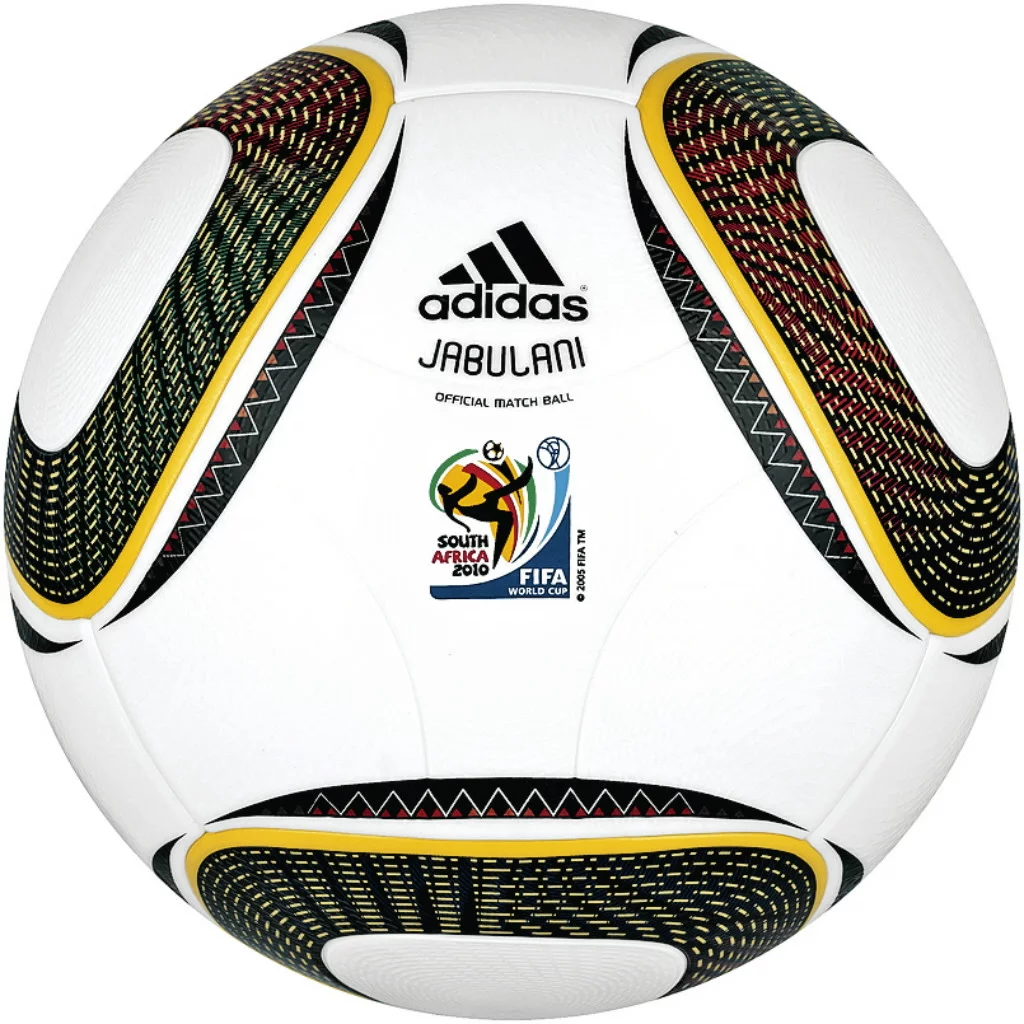
Detail of the Jabulani, a ball with a very attractive design but considered the worst performing ball in World Cup history.
BRAZIL 2014
After the harsh criticism adidas received for the 2010 ball, it had its work cut out for it with the ball for the next World Cup. The eyes of the football world were on Brazil, and adidas pulled a new work of art out of its sleeve: the Brazuca.
The name “Brazuca” means “Brazilian” in colloquial language and is used to describe the country's way of life. The name was chosen through a competition organised by adidas in which Brazilian citizens could propose and vote for names for the ball. Of the many proposals, the finalists were: Carnavalesca, Bossa Nova and Brazuca. The design is a representation of the colourful bracelets popular in the country of samba; the stars included on the ball are like those on the flag and serve to pay tribute to Brazil, the host country of the World Cup.
On a technical level, after the Jabulani fiasco, the Brazuca was the ball that passed the most tests in history. Over two and a half years, it was tested by more than 600 top-flight footballers and 30 teams in ten countries across three continents. As a final test, the Brazuca was used to play the Under-20 World Cup held in Turkey in 2013, albeit with the design camouflaged under the Cafusa ball decoration.
The Brazuca ball is made of six propeller-shaped panels that are thermally bonded together. The Jabulani, meanwhile, had eight sections, the Teamgeist had 14, and a traditional ball has 32. Adidas strove to ensure that the ball had a continuous and stable flight, and it does so by agitating the air: the external roughness produced essential agitation to increase the flight time and stability. A smooth ball receives more impact and loses speed.
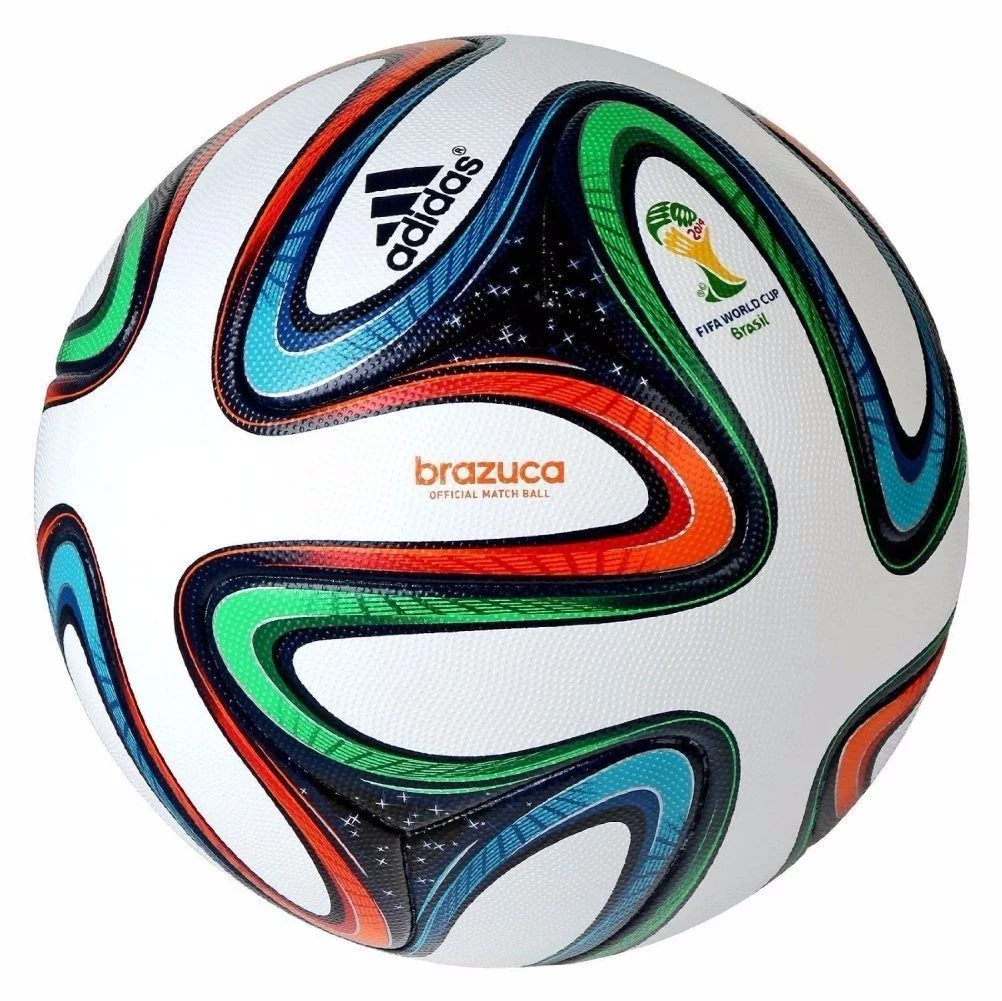
adidas Brazuca, the ball with which the German brand regained the confidence of footballers
RUSSIA 2018
The Telstar 18, the official ball of the 2018 World Cup in Russia, brought back the legendary black and white design of the original Telstar with a completely new approach. It featured a six-panel heat-sealed construction and a textured surface to improve control and stability in flight. It was also the first World Cup ball with an integrated NFC chip, combining tradition and technological innovation.

QATAR 2022
We travelled to Qatar, host of a historic World Cup: the first ever held in a Middle Eastern country. For such a special occasion, adidas presented the Al Rihla, a ball whose name translates as “travel journal”, in clear reference to the journey it made before the World Cup through various social initiatives around the world. In terms of technology, the Al Rihla stood out for its 20 PU panel construction and innovative Speedshell technology, designed to increase speed and improve the ball's spin during flight, offering more precise and faster performance on the pitch.

In terms of aesthetics, this ball perfectly represents the architecture, culture and essence of Qatar. It also marked a turning point in sustainability, as it was the first official World Cup ball whose glue and dyes were water-based, thus reducing its environmental impact.

For the decisive stages of the tournament, adidas unveiled the ‘Al-Hilm’, a clear reference to the dream shared by all nations of lifting the World Cup trophy.
USA , MEXICO AND CANADA 2026
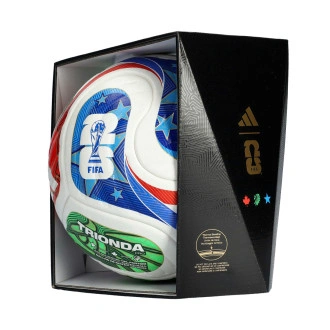
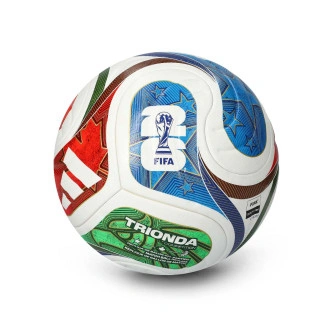
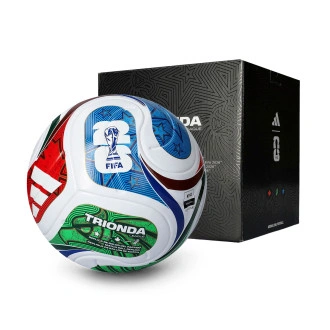
And we come to the latest official FIFA World Cup ball to date: the adidas Trionda. For the first time, a World Cup will be hosted by three countries and will feature 48 teams, adding an extra knockout round. The challenge for adidas was enormous: to represent the identity of the United States, Canada and Mexico in a single ball. The result is a very striking design, constructed with only three panels — the ball with the fewest panels in history — featuring clear symbols of each country: the stars of the United States, the maple leaf of Canada and the eagle of Mexico.

It is also the most technologically advanced ball to date, as it incorporates a chip in its inner layer that can detect points of impact, speeding up refereeing decisions and supporting VAR. To avoid compromising performance, adidas incorporated counterweights in the remaining panels, thus maintaining the stable and predictable flight that characterises the Trionda.

What do you think of this new adidas Trionda? It is available at Fútbol Emotion!